
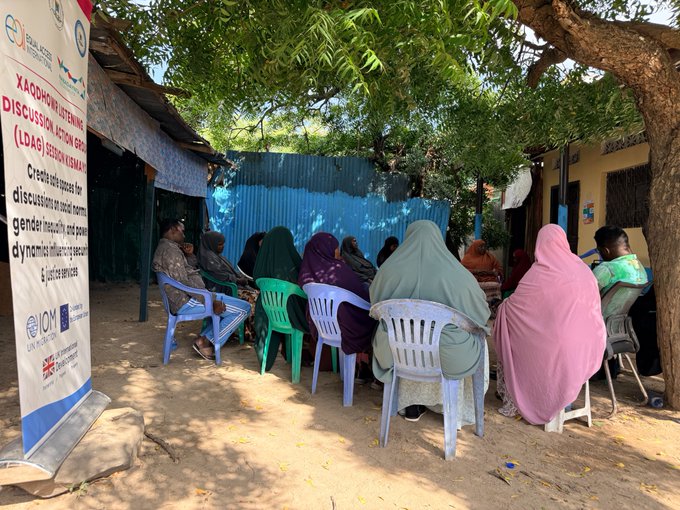
In the heart of Kismayo, conversations once sparked by the Xaqdhowr radio drama are now driving real transformation within communities. Through the Nabadaynta Programme, funded by IOM and Equal access international (EAI) and implemented by WASDA, community members have taken the step from listening to acting, coming together each week in Listening, Discussion, and Action Groups (LDAGs) to reflect, learn, and lead change.
Building Understanding from the Ground Up The LDAG sessions brought together men, women, youth, IDPs, Security and justice actors. Each group represents a diverse mix of voices and perspectives, ensuring that dialogue remains inclusive and community-driven. Session Zero introduced new participants to the Nabadaynta Programme, a platform that strengthens justice, security, and social cohesion through open dialogue. Returning members from earlier seasons shared how they had applied lessons from past discussions to resolve disputes, promote fairness, and advocate for accountability in their communities. “I feel committed to applying my knowledge to promote peace, fairness, and cooperation among the people around me,” said one participant from the adult women’s group.
Standing Up for Justice and Equality As the sessions progressed, participants engaged deeply with the radio storylines, using them as mirrors to reflect on real-life challenges. Session One, ‘Power and Discrimination,’ opened honest discussions on how power imbalances and clan favoritism affect access to justice. Participants shared powerful personal experiences, from a young shoe shiner deceived by a shopkeeper to families losing land due to corruption. These stories revealed the painful reality of how discrimination and misuse of authority deny fairness to the most vulnerable.
“When those in power misuse their authority, and the system turns a blind eye, justice becomes a privilege, not a right,” shared a male youth participant. Through dialogue, participants agreed that justice must be rooted in equality, and that both formal and traditional systems should protect, not marginalize, vulnerable people. The groups proposed community awareness campaigns, legal education, and stronger collaboration between elders, courts, and local authorities.
Breaking the Silence on Stigma and Blame Session Two, ‘Standing Up Against Stigma and Blame,’ brought emotional and courageous conversations about the silence surrounding survivors of gender-based violence (GBV). Participants listened to the radio episode highlighting how stigma and victim-blaming prevent survivors from reporting abuse or seeking help.
Community members and local leaders discussed how harmful social norms can isolate victims, particularly women and girls, who are often blamed instead of protected. In one story shared during the session, a young girl was harassed by a neighbour, only to be blamed by elders during mediation. Her experience opened the group’s eyes to the urgent need for survivor-centred justice. “When the community blames the victim, we protect the wrong person, and the problem continues,” said one participant.
The sessions encouraged empathy and accountability, leading to real actions in Kismayo’s communities. Women began leading neighbourhood conversations on safety and respect. Youth partnered with local police to prevent gang activity, while religious leaders addressed justice and fairness in their sermons. Police officers, in turn, reported that community members were now approaching them more openly with concerns, a significant shift in trust and cooperation. “Before, people feared us. Now they call us for help, that’s a big change,” said a police officer who participated in the LDAG sessions.
Dialogue That Inspires Action Each LDAG meeting is more than just a discussion, it’s a step toward collective action. Participants are encouraged to take home what they learn and apply it in their daily lives, promoting fairness, compassion, and responsibility. The gradual shift in attitudes is evident. Facilitators observed that participants have become more confident, empathetic, and united. Men are challenging traditional biases, women are finding their voices, and community leaders are realizing the power of inclusion and dialogue. “Every time we talk, we learn to listen more and blame less, that’s how real change starts,” one participant reflected.
A Path Toward Peaceful Coexistence The Nabadaynta LDAGs have become a bridge between communities and institutions, proving that sustainable peace begins with understanding and trust. Through shared learning, storytelling, and reflection, the people of Kismayo are building stronger, fairer, and more inclusive communities. As the season continues, WASDA and its partners remain committed to nurturing these spaces where voices are heard, attitudes change, and justice becomes -shared responsibility.
